


Bitcoin mining may be providing incremental support to the Russian ruble, Central Bank Governor Elvira Nabiullina said, while cautioning that the effect is difficult to measure because much of the sector still operates in a legal and reporting gray zone.
Bitcoin Mining May Support The Ruble
Responding to a question at a press conference, Nabiullina said it is “probably difficult to quantify” mining’s influence “because a significant part of mining is still in a gray area.” Still, she added that mining is “indeed one of the additional factors contributing to the strong ruble exchange rate.”
As Russian business news portal for RBC reported, her remarks come as Russian officials increasingly frame mining and crypto flows as macro-relevant, not just a niche tech or energy story. Earlier, Maxim Oreshkin, deputy head of the presidential administration, said ruble forecasts have been thrown off by the underestimation of financial flows tied to mining and cryptocurrency. In his view, the sector has effectively become a new export item that can influence the currency market, in part because it moves outside standard channels and therefore stays statistically “invisible.”
Nabiullina did not endorse a direct, one-to-one link between ruble strength and a sudden surge in mining. She stressed that mining did not appear in 2025, so it would be incorrect to attribute the ruble’s strengthening specifically to a sharp rise in mining activity this year. “This mining did not appear this year, so it is impossible to link the strengthening of the exchange rate specifically to the fact that it has somehow grown sharply,” she said. “There is probably some increase. Nevertheless, mining is indeed one of the additional factors contributing to the strong ruble exchange rate.”
Crypto Legislation Is Coming?
The central bank’s emphasis on measurement and legality is also tied to its broader push to “whiten” Russia’s Bitcoin and crypto market — bringing activity into a more formal framework where it can be monitored, constrained, and accounted for. Last week, first deputy chairman Vladimir Chistyukhin said it is now fundamentally important to “legalize” the cryptocurrency sector and called for laws governing crypto transactions to be adopted as soon as possible, including strict restrictions and prohibitions.
In parallel, the central bank is discussing rules for crypto trading with the Finance Ministry, Rosfinmonitoring, and other agencies. Under the approach described, crypto transactions would be conducted primarily through existing market participants operating under existing licenses, rather than through informal venues or bespoke structures.
Meanwhile, Anatoly Aksakov, the chairman of the State Duma Committee on Financial Markets, clarified last week that cryptocurrencies “will never” function as money inside Russia or in global trade.
For crypto markets, the significance is not that Russia has officially “blamed” or “credited” mining for the ruble’s moves. It is that senior policymakers are increasingly treating mining-linked flows as an input into currency-market dynamics — while pushing for regulatory plumbing that would make those flows easier to see, categorize, and control.
At press time, Bitcoin traded at $88,927.
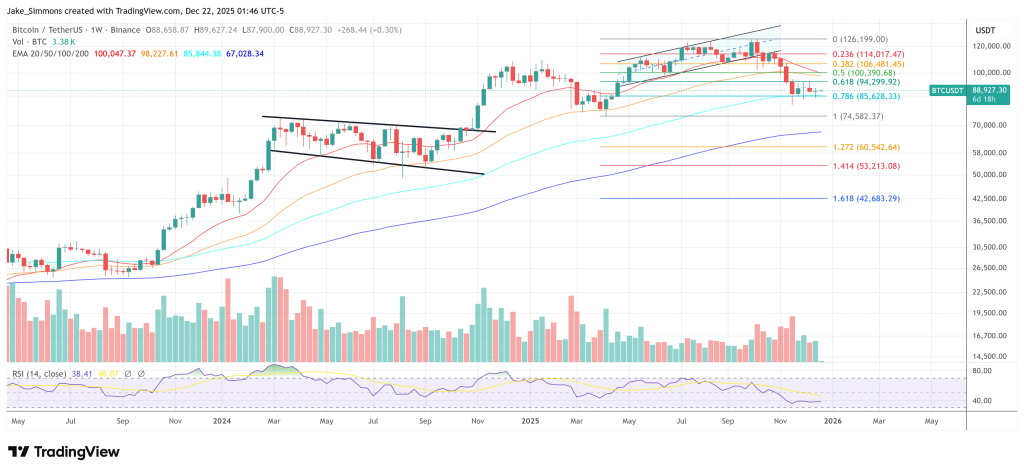
Featured image created with DALL.E, chart from TradingView.com
Editorial Process for bitcoinist is centered on delivering thoroughly researched, accurate, and unbiased content. We uphold strict sourcing standards, and each page undergoes diligent review by our team of top technology experts and seasoned editors. This process ensures the integrity, relevance, and value of our content for our readers.